Assisted Living or Memory Care? A Guide for Niles Families
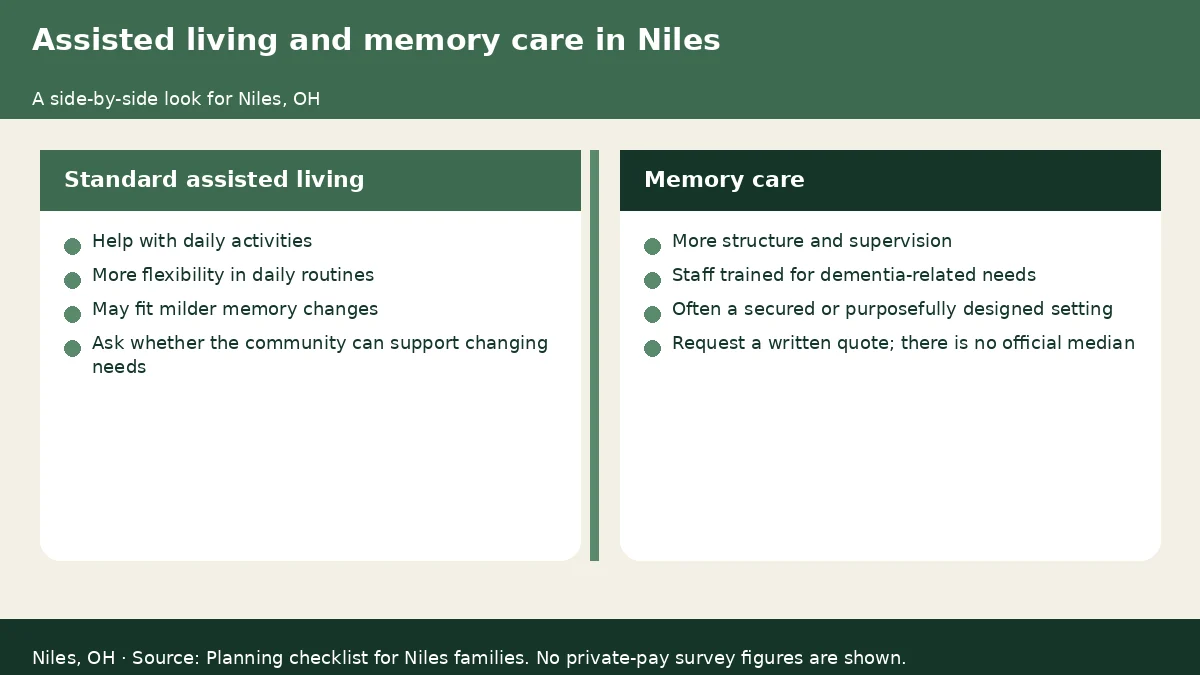
In Niles, memory care is a more structured setting than standard assisted living, often with additional staffing and security. Whether someone needs that setting depends on their safety and daily-care needs, not on a national average price. Ask communities for written quotes for both options when both are appropriate.
Medicare does not pay for room, board, or ongoing custodial care in assisted living if that is the only care someone needs (Medicare.gov: long-term care coverage).
Eligible wartime Veterans and surviving spouses can review VA pension with Aid and Attendance. As of December 1, 2025, the maximum annual pension rate with Aid and Attendance is $29,093 for a Veteran with no dependents and $34,488 for a Veteran with one dependent (current VA pension rates). A surviving spouse’s Aid and Attendance maximum is $18,697 a year with no dependent children (VA Survivors Pension rates). These are benefit limits, not the price of a Niles community. The net worth limit for these pensions is $163,699 from December 1, 2025, through November 30, 2026.
For local public-benefit counseling, start with the federal Eldercare Locator at 1-800-677-1116, which connects families to the Area Agency on Aging that serves Niles, Ohio.
Families in Niles often start by searching for "assisted living," then discover that many communities also talk about memory care. The two can look alike from the parking lot. Both offer a private room, meals, and help with daily life. But they are built for different people. Picking the right one can make your parent's days calmer and safer, and can spare everyone a second move a few months later. This guide lays out the differences and gives you practical ways to decide.
Assisted living in a nutshell
Assisted living is for older adults who are largely independent but need a hand with some parts of the day, such as bathing, dressing, medications, or getting to meals. Residents typically have their own apartment, choose their own activities, and keep much of their usual routine.
In Ohio, assisted living is licensed as a residential care facility by the Ohio Department of Health. The Department explains that these facilities provide accommodations, supervision, and personal care services, and may provide limited skilled nursing care, for example up to 120 days in a 12-month period, under specific conditions (Ohio Department of Health, residential care facilities).
Memory care in a nutshell
Memory care is for people living with Alzheimer's disease or another dementia whose needs have moved beyond what standard assisted living can safely meet. It usually adds:
- Secured exits and supervision to lower the risk of wandering
- Staff trained in dementia care, including calm redirection and reading nonverbal cues
- A predictable daily rhythm that reduces anxiety
- Activities matched to ability, such as music, folding laundry, or a short walk
- More hands-on help with eating, dressing, and personal care
The Ohio Department of Aging notes that its Assisted Living Waiver includes a memory care service alongside basic assisted living (Ohio Department of Aging, assisted living).
Memory care gives support and a safer setting. It does not reverse or cure dementia.
Comparing the two
| Assisted living | Memory care | |
|---|---|---|
| Best for | Older adults needing some daily help | People living with dementia |
| Setting | Open, more independence | Secured, simplified, calm |
| Staff | Help with daily tasks | More time per resident, dementia training |
| Activities | Wide social calendar | Structured, ability-based |
| Cost | Lower | Higher |
What about cost?
The survey does not track memory care separately. Our guide to memory care costs in Niles explains more.
Signs assisted living may fit
- Your parent needs help with a few tasks but follows conversations and makes choices
- Medication reminders and regular meals would solve most of the problems
- Your parent feels lonely at home and would enjoy company
- Memory changes are mild, and there is no wandering
- Your parent can call for help and use an emergency pendant reliably
Signs memory care may fit better
- Wandering or trying to leave, especially after dark
- Getting lost on routes your parent has driven for decades, such as to the Eastwood Mall or church
- Not recognizing hazards, such as a hot burner or slippery steps in winter
- Needing step-by-step prompts to dress or bathe
- Agitation, fear, or confusion that rises in the late afternoon
Early dementia is a gray area
Many people in the early stages of dementia live well in assisted living with reminders and a steady routine. The question is how quickly things may change. Ask your parent's doctor what to expect, and ask each community what happens if your parent later needs memory care. Find out whether they would need to move buildings, whether the rate changes, and who makes that decision.
Try a short stay
Some communities offer short respite stays. A week or two can show how your parent responds to group dining, new routines, and staff support, and can give a family caregiver a real rest. Ask whether this is possible and how it is priced.
Get a medical view
A physician, ideally one experienced with older adults, can help you understand your parent's abilities and likely needs. Bring a short log of recent incidents: missed pills, falls, getting lost, or unusual behavior. Specific examples help the doctor give clearer advice. Many communities also complete their own assessment before move-in.
Questions to ask any community
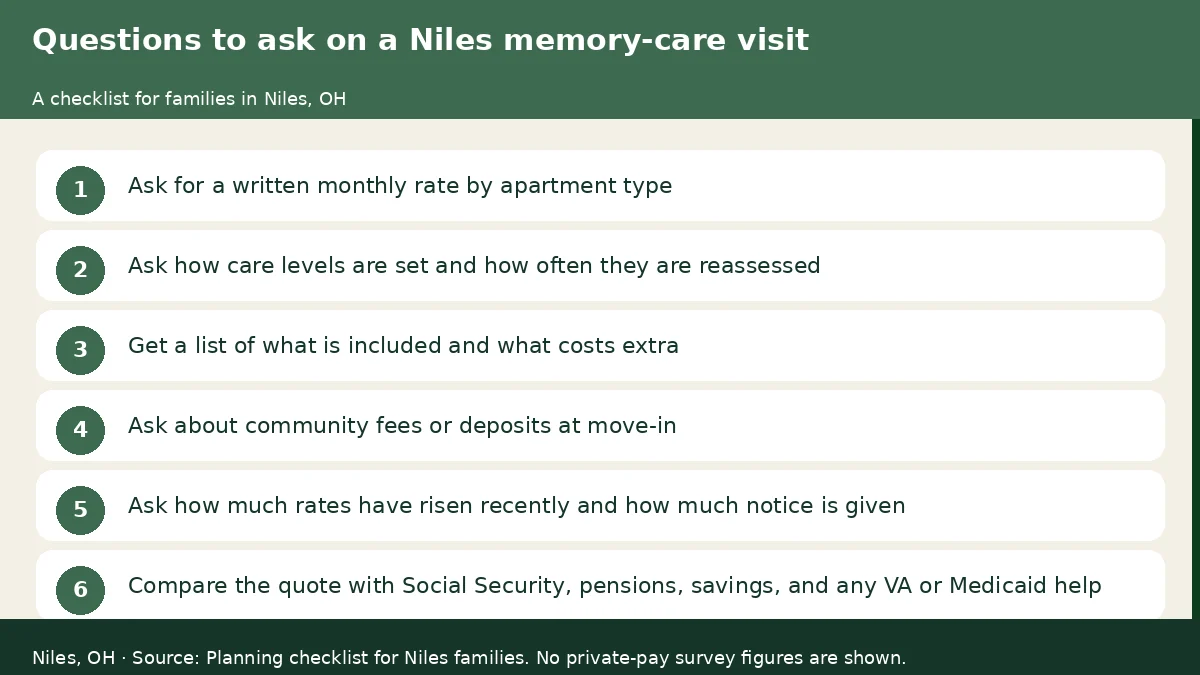
- How do you decide between assisted living and memory care for a new resident?
- What dementia training do staff receive, and how often?
- How do you prevent and respond to wandering?
- How do you handle sundowning without relying on medication?
- What happens if my parent's needs exceed what you provide?
- How do charges change if my parent moves to memory care?
When family members disagree
Siblings often see a parent differently. The one who lives in Niles may see the daily struggles, while a brother in Columbus or a sister in Pittsburgh sees only good days on the phone. A shared written log, a joint doctor visit, and touring both kinds of settings together can help everyone reach the same picture. The aim is not to win the argument but to find where your parent will be safe and comfortable.
Helping your parent adjust
Familiar things make a new room feel like home: a favorite chair, a family quilt, photos on the wall. Share your parent's routines, likes, and life story with staff, so they can connect with your parent as a person. Label drawers and doors with simple words or pictures if that helps. Visit often at first, but take cues from staff about whether short, calm visits are working better than long ones.
Local help
Direction Home of Eastern Ohio, which serves Trumbull County, can explain care options and Medicaid waiver services at 330-505-2300 or 800-686-7367 (Direction Home of Eastern Ohio).
Talk with Gracewoods Senior Living
Gracewoods Senior Living, at 1800 Gracewoods Drive in Niles, offers assisted living and describes its approach to memory care. Please call (330) 652-4177 to confirm which kinds of support are available today and what they cost. Visiting hours are from 9 to 5. We're open 24 hours.
Frequently asked questions
What is the main difference between assisted living and memory care?
Assisted living helps with daily tasks in an open setting. Memory care adds a secure environment, dementia-trained staff, and a structured routine for people living with dementia.
Can a person with dementia live in assisted living in Ohio?
Many people in the early stages do well in assisted living. As needs grow, memory care may be safer.
Is memory care more expensive?
Yes.
Does Ohio's Assisted Living Waiver cover memory care?
The Ohio Department of Aging says the waiver includes a memory care service, for eligible residents in participating facilities.